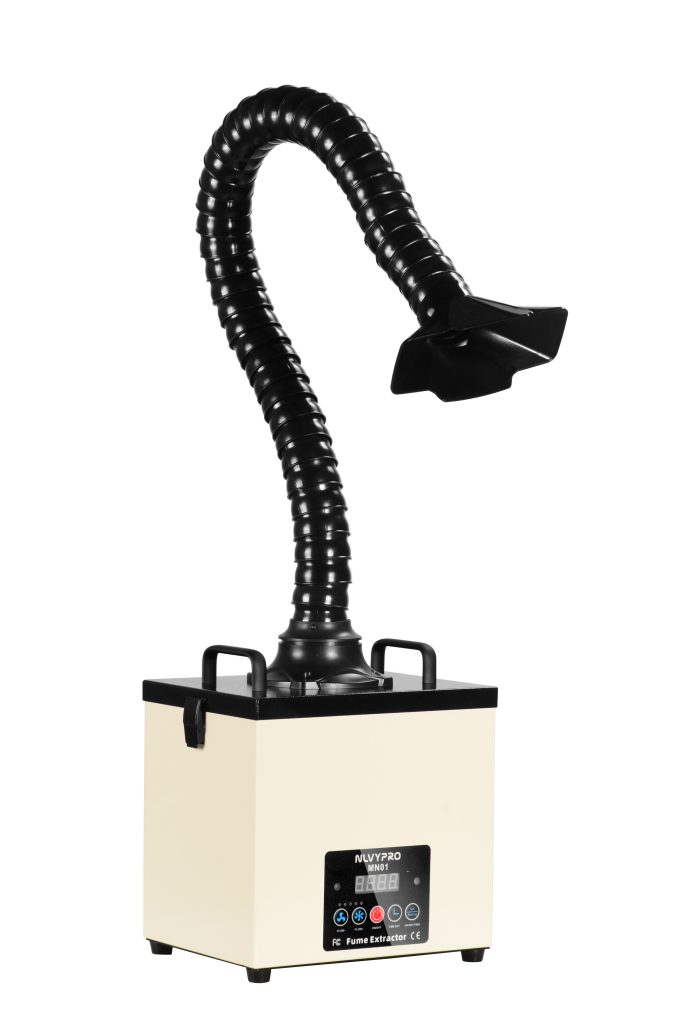
A soldering fume extractor is used to capture fumes close to a solder joint before they spread across the workbench. Common applications include PCB assembly, electronics repair, wire soldering and prototype development. The capture position, hose layout and filter condition matter as much as choosing the unit.
Where are soldering fume extractors used?
The useful starting point is the work itself: where the joint is made, how often it moves and whether one operator or several people need extraction. A hose that works beside a small circuit board may need repositioning when the same bench is used for a long cable assembly.
| Application | Typical task | Setup consideration |
|---|---|---|
| PCB assembly | Soldering components to a circuit board | Keep the capture inlet beside the active joint without blocking the iron or inspection light. |
| Electronics repair | Replacing connectors or individual components | Allow room to reposition the inlet as the board turns. |
| Wire and connector work | Tinning wires and joining cable terminals | Place the work in a consistent capture area rather than following each joint with a distant hood. |
| Prototyping | Short soldering sessions across changing assemblies | Check the hose position each time the fixture or workpiece changes. |
Start with our soldering fume extractor range to compare available models, then check the manual against your bench layout.
Why capture fumes at the soldering point?
The UK Health and Safety Executive identifies rosin-based solder flux fume as an occupational asthma hazard and recommends extraction and regular maintenance. It also advises keeping the operator’s head out of the rising plume. See the HSE guidance for solderers.
In practical bench planning, leave a clear route from the joint toward the capture inlet. A room fan aimed across the bench can disrupt that route. An extractor should be part of the workplace’s ventilation and exposure-control plan; a product photograph or visible smoke demonstration cannot establish exposure control for every task.
How to set up extraction at a soldering bench
- Identify the normal joint position. Arrange the board holder, iron stand and lighting before positioning the hood.
- Bring the inlet close to the source. Follow the extractor’s instructions for placement. Use the placement guidance for the specific hood and task.
- Keep access clear. Make sure the hose does not force the operator to lean into the fume path.
- Check the hose and lid. Remove avoidable bends and confirm that connections, filter seating and the cover are secure.
- Recheck when the task changes. A different fixture, board orientation or nearby fan can change the capture arrangement.
If several benches need extraction, do not assume that adding hose branches to a single-inlet unit will serve all stations. Ask for a system assessment based on simultaneous use and the actual duct layout.
Plan filter inspection into the workflow
Inspect the pre-filter and intake path regularly. Record maintenance so a gradual change in extraction does not become normal. Reduced capture can have several causes, including a blocked hose, loaded filter or poor cover seal; check the cause rather than simply increasing the setting.
Follow model-specific instructions when replacing filters. Do not wash a HEPA or odor filter unless the manual expressly permits it. Our product manual library provides the MN01 and MN02 documents for installation and maintenance.
MN01 or MN02: what should you compare?
NLVYPRO MN01 is a 110V, 105W unit with an adjustable hose and three filtration stages. NLVYPRO MN02 is a 110V, 200W unit with four filter layers and a wheeled cabinet. Use these specifications to narrow the options, then compare the capture arrangement and workspace fit.
| Detail | MN01 | MN02 |
|---|---|---|
| Power supply | 110V AC | 110V AC |
| Rated power | 105W | 200W |
| Filtration | 3 stages | 4 layers |
| Cabinet dimensions | 10.8 × 8.5 × 12.2 in | 12.2 × 9.9 × 18 in |
Rated electrical power alone does not establish capture performance. Review the complete setup and ask about requirements that are not specified on the product page.
Common questions
Does occasional soldering still need an extraction plan?
Consider the flux, task, duration and workplace conditions. A short session still produces fumes. Use the flux safety information and an appropriate assessment to decide the controls.
Can one extractor also serve a laser engraver?
The setup must be checked separately. Laser materials, enclosures and exhaust connections introduce different requirements. Read our guide to choosing a laser engraving fume extractor before sharing equipment between tasks.
Where should I ask a model-specific question?
Contact NLVYPRO with the soldering task, number of stations, operating time and available bench space. Include a photograph or sketch of the proposed hose route if possible.
 Scan to chat on WhatsApp