
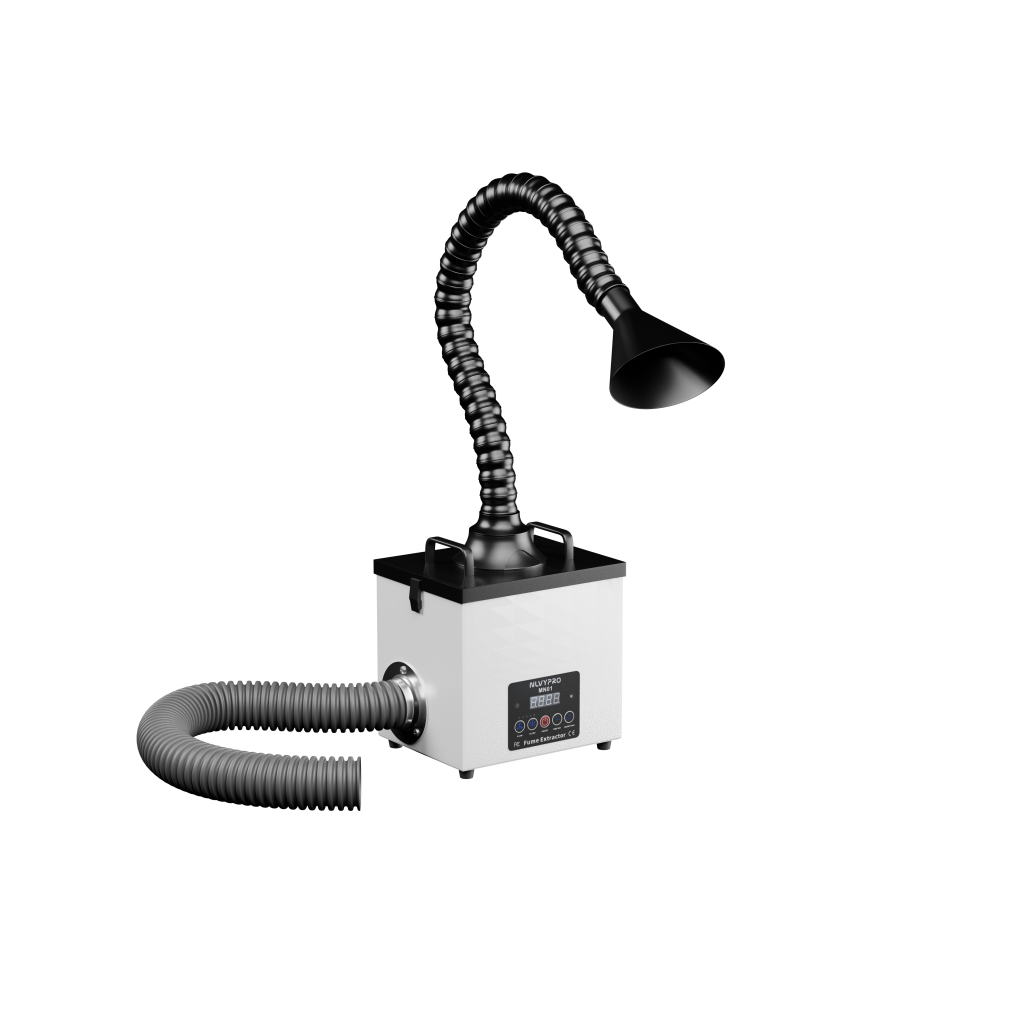
Choose a laser engraving fume extractor by matching the material, machine enclosure, extraction connection, airflow requirements and filter maintenance plan. Laser wattage is one detail; it does not tell you everything about the fumes produced or the extraction system needed.
1. Identify the materials you will engrave
Write down the exact material, coating and supplier information for your regular jobs. A coated board, a bare piece of wood and an engraving laminate should not be treated as the same process simply because they fit inside the same machine. Use the material supplier’s information and the laser manufacturer’s approved-material guidance.
Do not use an extractor to justify processing an unsuitable material. Trotec identifies PVC, vinyl and several other plastics as unsuitable for laser processing because of hazardous emissions. See its laser-processing guidance for plastics. Confirm unknown plastics before starting a job.
Also describe your workload: occasional personalization, repeated batches or long jobs. This information helps the supplier discuss filter loading and maintenance requirements without guessing from the laser’s advertised power.
2. Match the enclosure and hose connection
An open capture hood beside a work surface is a different arrangement from a hose attached to an enclosed laser machine. Before buying, inspect the enclosure outlet, available adapter space and the route to the extractor.
- Port diameter: measure the actual connection and check whether an adapter is required.
- Hose route: note the length, tight bends and any restrictions.
- Enclosure: check the laser manufacturer’s ventilation instructions and extraction connection.
- Installation space: allow access to the lid, filters, controls and hose fittings.
Ask the laser manufacturer for its extraction requirements. Then ask the extractor supplier whether the proposed system can meet them with the planned hose and filters. A free-air airflow number, where provided, should not be treated as a guarantee of flow through every installed arrangement.
3. Review particle filters, odor filters and exhaust routing
Check which filter components are fitted, how they are accessed and how replacements are obtained. A pre-filter, HEPA filter and odor-filter component have different maintenance requirements. The number of layers alone is not enough to establish suitability for a particular material.
Distinguish a filtered-air arrangement from one that also routes exhaust outdoors. For an outdoor route, confirm where the air will discharge and how the hose will be installed. For either arrangement, review the material and process requirements rather than assuming that reduced odor proves adequate control.
Our extractor manuals describe the model-specific installation and filter arrangements. Keep those instructions alongside the laser machine’s own operating information.
4. Compare operating details, not just electrical watts
Check the supply voltage, dimensions, hose options, operating controls and maintenance access. Electrical input power describes consumption; it does not independently establish capture performance or compatibility with a particular laser.
When information is missing, send the supplier a simple installation brief: machine model, laser type and optical power, materials, outlet size, hose length and typical operating time. This produces a more useful answer than asking whether an extractor is suitable for “a desktop laser.”
5. Understand the MN01W and MN02 options
| Detail | NLVYPRO MN01W | NLVYPRO MN02 |
|---|---|---|
| Power supply | 110V AC | 110V AC |
| Rated power | 105W | 200W |
| Filtration | 3 stages | 4 layers |
| Hose information | Side exhaust connection; 76 mm × 2 m exhaust hose | 75 mm × 1 m articulated hose; 75 mm × 2 m flexible hose |
| Selection boundary | For 5W laser engraving and cutting machines only | Confirm the machine, material and extraction requirements before selecting |
MN01W is for 5W laser engraving and cutting machines only. Its side connection supports the outdoor exhaust arrangement described in the shared manual. The 5W limit does not remove the need to check material suitability and installation.
MN02 offers a 200W, four-layer filter arrangement with a wheeled cabinet and hose options. Do not assume that 200W electrical input makes it suitable for every higher-powered laser. Confirm the complete setup with the supplier.
Browse the laser engraving fume extractor category for available models. If you also cut materials, review the laser cutting extraction range against those jobs separately.
Before ordering: a practical checklist
- Confirm the material and coating are approved for your laser process.
- Record the laser model, enclosure outlet and manufacturer’s extraction requirements.
- Measure the hose route and list the necessary fittings.
- Confirm the extractor’s voltage, filters, maintenance access and replacement availability.
- Check the permitted setup and any model-specific limits.
- Review the exact Amazon package and installation manual.
Common questions
Is a HEPA filter enough for every laser material?
No. Review the complete filter arrangement, material emissions and ventilation requirements. The presence of a HEPA filter does not establish that the system handles every gas or vapor produced by laser processing.
Can I use MN01W with a 10W laser?
MN01W is specified here for 5W laser engraving and cutting machines only. Contact us to review another arrangement for a different machine.
Can a soldering extractor be connected to a laser enclosure?
Check the model’s supported arrangement and the laser’s requirements first. Our soldering extractor application guide explains why a close capture hood at a solder joint is a different setup.
 Scan to chat on WhatsApp